Welcome to this beginner’s guide to reading piano sheet music! If you are discovering the world of music and want to learn to play the piano, knowing how to read sheet music is absolutely essential. But do not worry if you do not know where to begin: that is where this guide comes in. In this guide, I will give you all the tips and advice you need to learn how to read piano sheet music and start playing your favorite instrument.
Whether you are a complete beginner or already have some musical experience, this guide will help you understand the basics of musical notation, decode piano sheet music, understand musical rhythm, master the treble and bass clefs, and use different techniques to improve your sight-reading. In the following sections, we will examine every aspect of this skill in detail.
Ready to begin? Let’s get started!
The Basics of Musical Notation
To learn how to read piano sheet music, it is important to understand the basics of musical notation. First, reading musical notes begins with the treble clef and bass clef, which indicate high and low notes respectively.
In the treble clef, notes are placed on the lines and in the spaces, representing G, B, D, F, and A, and F, A, C, and E respectively. In the bass clef, notes are placed on the lines and in the spaces, representing G, B, D, F, and A, and A, C, E, and G respectively.
It is also important to understand note duration. For example, a whole note, which looks like a circle, lasts four beats, a half note two beats, a quarter note one beat, an eighth note half a beat, and so on.
Types of Notes:
| Type of note | Duration in beats |
|---|---|
| Whole note | 4 |
| Half note | 2 |
| Quarter note | 1 |
| Eighth note | 1/2 |
It is advisable to practice reading simple sheet music before moving on to more complex pieces. With practice, reading musical notes will become easier and more intuitive.
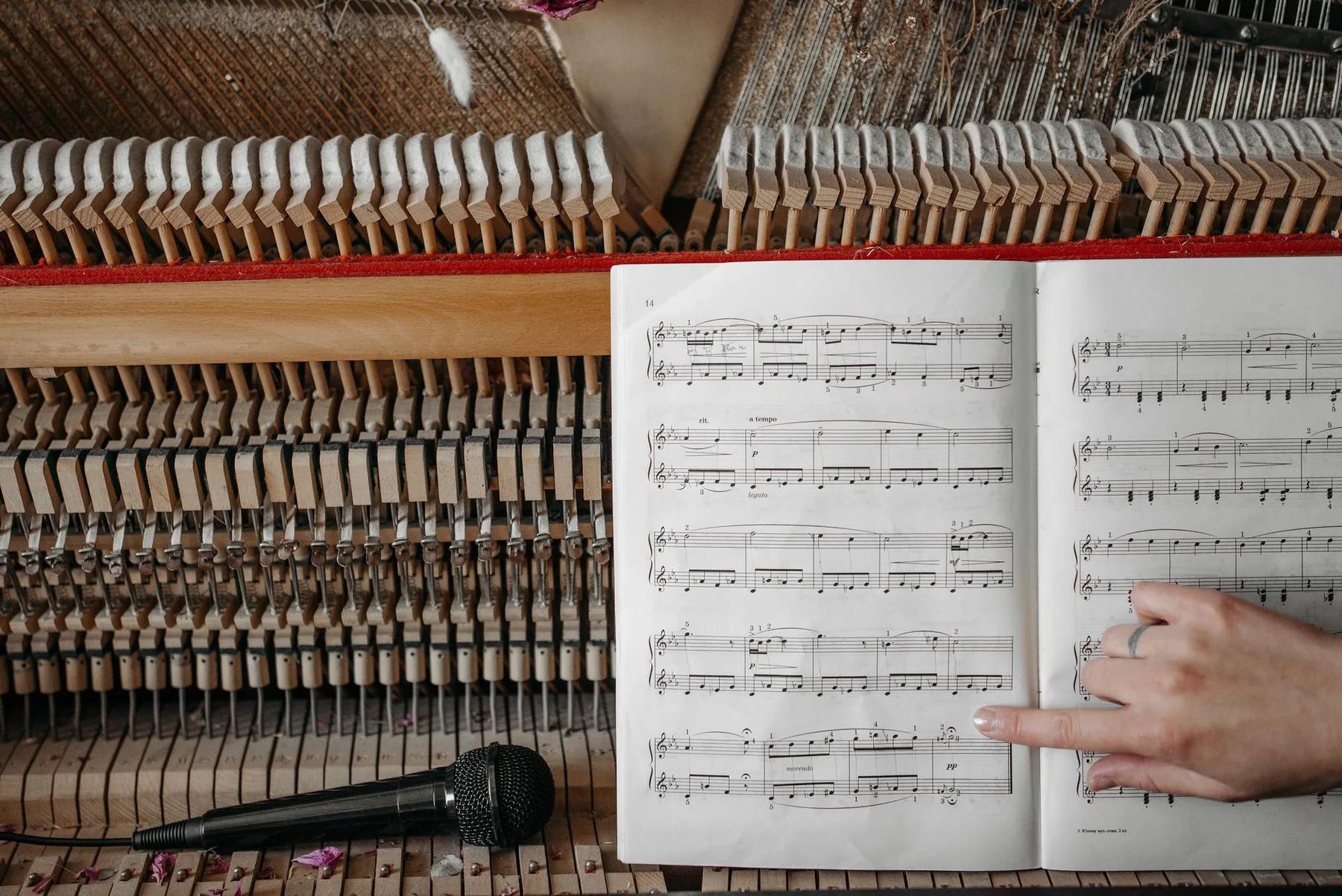
One useful tip is to practice reading sheet music slowly while counting the beats in your head. Do not hesitate to write the fingerings on the score to better understand where to place your fingers on the keyboard.
Once you understand the basics of musical notation, reading piano sheet music will become easier and more enjoyable. All that remains is to practice regularly until you become a true sheet-music-reading professional!
Decoding Piano Sheet Music
To decode piano sheet music correctly, it is essential to understand the different elements that make it up. First, musical notes are represented by symbols on the staff. These symbols correspond to specific sounds produced by the piano keys. Notes also have a duration, indicated by the shape of the notehead and its position on the staff.
Next, you need to take rests into account. They are represented by symbols whose durations are similar to those of notes, but they do not have noteheads. Rests are just as important as notes to the quality of the music.
It is also crucial to understand the clef used in the score. The treble clef is generally used for high notes played with the right hand, while the bass clef is used for low notes played with the left hand.
Key signatures and accidentals are also very important. Key signatures indicate the key in which the music is written. Accidentals change the pitch of a note by sharpening or flattening it. It is important to become familiar with these symbols so that you can play the music correctly.
The Different Elements of Piano Sheet Music
To read piano sheet music effectively, you need to be able to recognize its different elements. Here are the main elements to identify:
| Element | Meaning |
|---|---|
| Note | Musical representation of a sound |
| Rest | Musical representation of a pause |
| Clef | Indicates the position of the note on the staff |
| Key signature | Indicates the key of the score |
| Accidental | Changes the pitch of a note |
| Rhythm | Indicates the duration of notes and rests |
| Dynamics | Indicates the intensity of the music |
By following these tips, you will be able to decode piano sheet music easily and play accurately and musically.
Understanding Musical Rhythm
Rhythm is one of the most important components of music and of reading piano sheet music. It is therefore essential to understand the basics of reading rhythm in order to play accurately and fluently.
The time signature is the first thing to look at when reading sheet music. It indicates the number of beats in each measure and the duration of each beat. For example, a 3/4 measure means that there are three beats in the measure and that each beat corresponds to a quarter note.
Notes also have a specific duration. Common note values include the quarter note, eighth note, and sixteenth note. Longer notes include the half note and whole note, with the value doubling each time the duration increases; for example, one half note is worth two quarter notes.

To count the beats, you need to know the value of each note and learn to divide them into equal durations. For example, in a 4/4 measure, you count four beats and a quarter note equals one beat. In a 6/8 measure, you count six beats and a dotted quarter note equals one beat.
To practice reading rhythms, it is important to begin slowly and count aloud while playing. It is also useful to focus on one hand at a time before playing with both hands.
The Main Sheet-Music-Reading Techniques
In addition to the basics of reading music, there are tips and techniques that make sheet music easier to read. Here are a few:
- Sight-reading: practice sight-reading as often as possible, trying to play a new piece of music every day. This will develop your reading skills and build your confidence.
- Memorization: learn to memorize key passages from your pieces. This can help you focus on reading and musical expression rather than on the mechanics of the notes.
- Markings: use visual cues to help you follow the notes, such as circles around important notes or arrows indicating changes in hand position.
- Visualization: practice visualizing the score in your mind outside your practice sessions. Imagine the movement of your hands and the sound of the music.
- Divide and conquer: divide difficult passages into small sections and work on them slowly until you have mastered them. Then combine the sections for a smoother performance.
Remember that regular practice is the key to success in music. Use these tips to improve your sheet music reading and achieve your goals as a pianist.
Mastering the Treble and Bass Clefs
The treble and bass clefs are two of the most important elements of musical notation for the piano. The treble clef is used to represent high notes, while the bass clef is used to represent low notes.
To read piano sheet music, it is essential to understand how to read and interpret musical notes in each clef. In both the treble and bass clefs, notes are represented by symbols placed on the lines and in the spaces of the staff.
To better understand how to read the notes in each clef, here is a diagram showing their position on the staff for each clef:
| Treble clef |  |
|---|---|
| Bass clef |  |
It is important to note that the treble and bass clefs can appear together in piano sheet music. This occurs when the melody contains notes in both the high and low registers.
To become familiar with reading each clef, it is recommended that you practice by reading simple pieces that use each one. With a little patience and practice, you will be able to master the treble and bass clefs and read piano sheet music easily.
Tips for Piano Beginners
If you are a piano beginner, reading sheet music may seem intimidating. But do not be afraid! With regular practice and a few useful tips, you can master reading piano sheet music in no time! Here are some tips to keep in mind:
- Practice regularly: regular practice is essential for improving your ability to read piano sheet music. Try to practice a little every day, even if only for a few minutes.
- Begin slowly: when you encounter a new piano score, start by reading it slowly, one measure at a time. This will help you understand the music better before tackling it in full and will make it easier to memorize the notes.
- Take your time: do not rush! Take the time to read each musical note so that you understand what is written on the score. Once you know the notes well, you can focus on the rhythm and on playing with both hands simultaneously.
- Work with a piano teacher: if you are having difficulty reading piano sheet music, working with a teacher can be very helpful. They can show you tips and techniques that will help you improve your sheet music reading more quickly.
- Be patient: learning to read piano sheet music takes time. Do not be too hard on yourself, and be patient. Remember that regular practice is the key to success.
- Choose your first pieces carefully: not all sheet music is created equal. Choosing quality sheet music makes learning easier. Buying your piano sheet music from Quickpartitions provides a good foundation for getting started.
With these useful tips, you are well on your way to mastering piano sheet music. Practice regularly, take your time, work with a piano teacher, and be patient: you will become an expert at reading sheet music in no time!
Conclusion
There you have it: you are now equipped to read piano sheet music! Remember that it may seem difficult at first, but with practice, you will improve quickly. Do not hesitate to go back and review the concepts whenever you feel the need.
Above all, enjoy playing the piano and learning new pieces. Nothing is more rewarding than seeing a score you have read turn into a beautiful melody beneath your fingers. I therefore encourage you to keep practicing, stay motivated, and enjoy every stage of your musical journey!



0 Comments